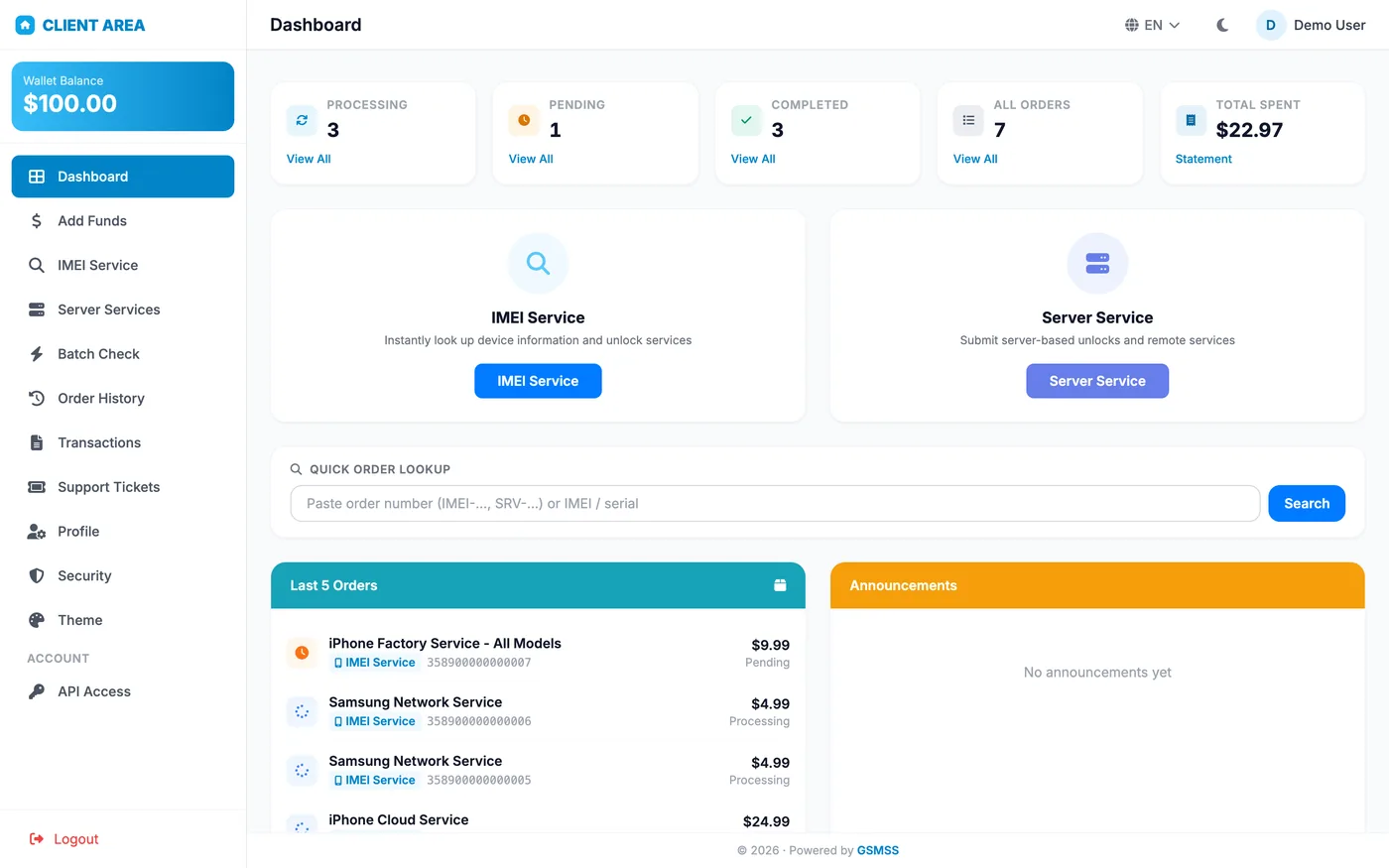
An IMEI server is the back-office engine of an IMEI unlock store. It keeps your service catalogue, customer accounts, balances, orders and supplier connections in one place. The storefront is the shop window. The server is everything behind the counter. People also call it an IMEI service panel or an IMEI service platform, and for a shop owner the three names mean the same thing.
What an IMEI server does
- Catalogue management: services, groups, prices, delivery-time labels and the fields a customer must fill in.
- Money handling: customer wallets, payments and order charges.
- Order routing: choosing which supplier receives each order and sending it.
- Status tracking: collecting results and updating the customer's order page.
Without that automation you copy order details between browser tabs by hand, which is slow and easy to get wrong.
The journey of one IMEI order
- Validation. The customer picks a service and submits the details. The server checks the required fields before anything else happens.
- Wallet billing. The price is charged to the customer's balance. Customers top up first and spend as they order.
- Routing. Each service is linked to a supplier service, and the server sends the order through the supplier's API.
- Waiting and polling. Suppliers work on their own timelines. The server checks for updates on a schedule and records every change.
- Result delivery. The customer's order page updates with the result or a rejection and its reason.
- Handling rejections. If a supplier rejects or cancels, your rules decide what happens, such as returning the charge to the wallet.
Where the Fusion API fits
For routing to work, your IMEI server and the supplier's system need a common language. In this industry that language is usually the DHRU Fusion API. It defines how to list services, place orders, check status and read balances. The same standard works in reverse: a reseller API lets smaller shops send orders into your server, which then treats them like any other order. That can become a second revenue line. Read more on DHRU Fusion API compatibility.
IMEI service panel: what to look for
- Several suppliers at once, so one slow provider does not stall your shop.
- Bulk import of supplier service lists, with prices that re-sync.
- A wallet with a full history and an invoice for each deposit.
- Clear rules for failed orders, so refunds do not depend on someone remembering.
- Staff roles so support agents never see your profit report.
Run your own IMEI server
GSMSS is an IMEI server that is hosted for you on your own domain, with every feature on every plan, a free 6-month trial and plans from $20 a month. Start with the GSM unlock server page for the launch steps, see how to start an unlocking website for the business side, or open the live demo.
Questions
What is an IMEI server? +
The back-office engine of an IMEI unlock store: it manages the service catalogue, customer wallets, orders, supplier routing and result tracking.
What is an IMEI service panel? +
Another name for the same thing. It is the admin side of a store that sells IMEI and server services, where you manage services, prices, customers and suppliers.
How do orders reach suppliers? +
Each service is linked to a supplier service. When a customer orders, the server validates it, charges the wallet and sends it to the supplier through its API, usually the DHRU Fusion API, then tracks the result.
Can I connect more than one supplier? +
Yes. GSMSS connects several supplier accounts at once and re-syncs their prices about every three hours.
Do I need my own server for an IMEI server? +
Not with GSMSS. Hosting, SSL, backups and updates are included in every plan.