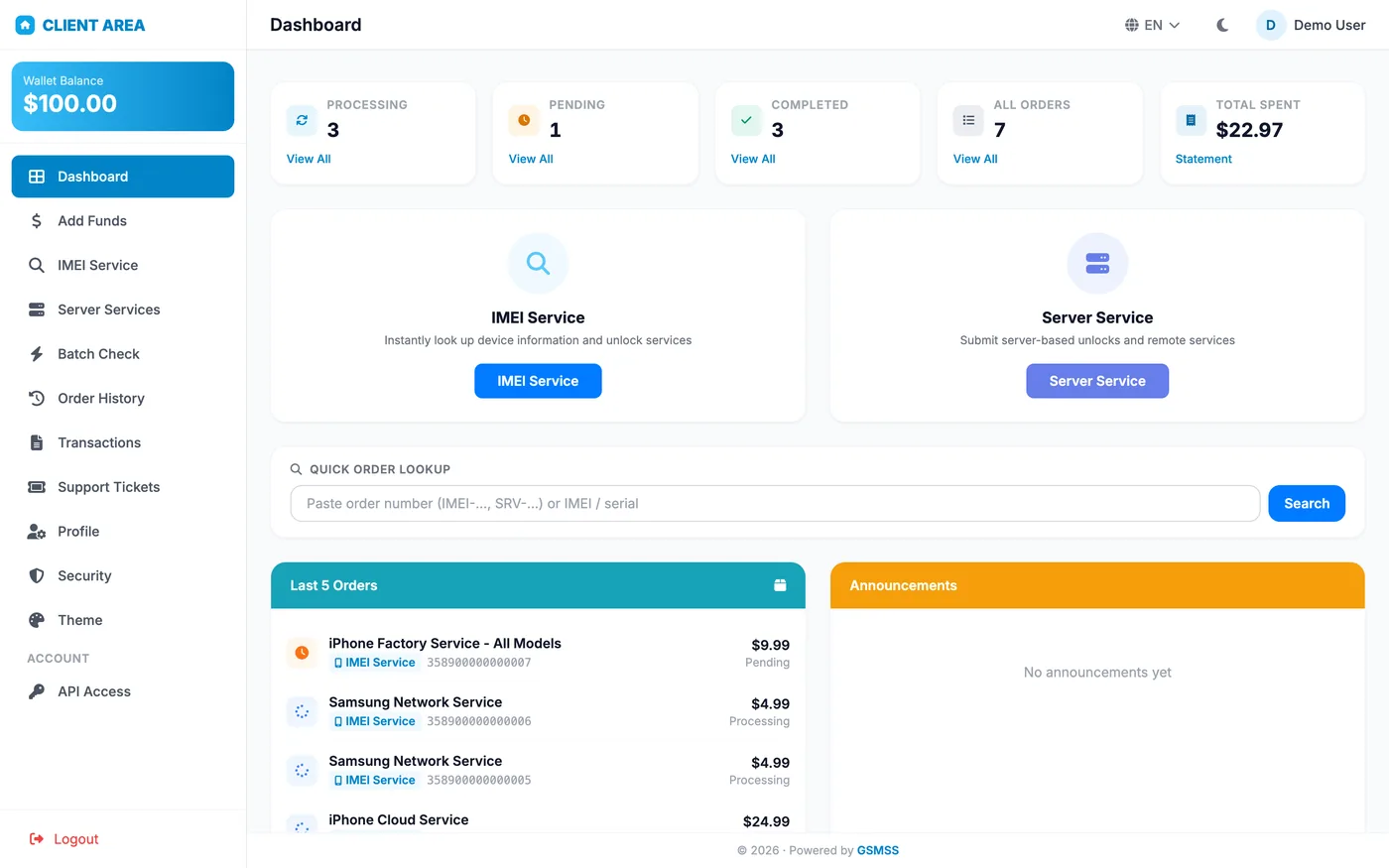
If you sell IMEI unlocks, network checks or server services, you need more than a price list. Customers expect a wallet, order history and a result they can copy. Resellers expect an API. You expect suppliers to fill orders without you watching the queue.
GSMSS is the software and the hosting for that shop. You pick a plan by server size. Every plan has the same 68 features: IMEI catalogue, server catalogue, prepaid wallet, Fusion and GSMSS API connectors, your own reseller API, tickets, reports and one-click updates.
What your customers see
- A public price list they can browse before they sign in.
- Service pages with the picture, delivery time, description and what they must send.
- Bulk IMEI paste when a service allows it.
- A wallet, invoices and a statement they can download.
- Nine languages and a theme they can change.
What you run in admin
- Groups, prices, required fields and a logo on every service.
- Supplier connections that place the order and bring the result back.
- Customer groups with their own discount.
- Staff accounts with permissions, plus a log of who changed what.
- Sales, deposits and best-seller reports with real profit, not just turnover.
An IMEI service catalogue you control
Your IMEI services sit in groups you name — by brand, by carrier, by turnaround — each with its own price, delivery time, picture and the fields a customer has to fill in. Import a supplier's whole list in one click, then hide what you do not want to sell and set a markup per group or per service. Customer groups get their own discount, so a reseller buying in volume sees their price, not the public one.
Server services work the same way, with custom fields for usernames, serial numbers or whatever the job needs. Both lists are public, so a visitor can check your price for a service before they ever make an account — which is exactly the page Google sends shoppers to.
An IMEI server, not just a price list
A price list tells people what you sell. An IMEI server takes the order, charges the wallet, sends the job to the right supplier and puts the result back in front of the customer — at three in the morning, with nobody watching. That automation is the difference between a shop that grows and a shop that is limited by how fast its owner can copy and paste.
GSMSS keeps a full record of every order: who placed it, what they paid, which supplier got it, and what came back. When a supplier clearly rejects a job, the charge goes back to the customer's wallet automatically; unclear failures wait for you to review. A daily wallet check flags any balance that does not match its transactions.
How an order moves
A customer (or their API) pays from wallet and submits an IMEI or the fields you defined. GSMSS sends the job to the supplier you attached. Status and the result come back into the same order. Instant services can finish before the page reloads. Longer jobs sit in Processing until the supplier answers. You can skip a duplicate warning per order when you mean to.
Hosting is part of the product
We install on your domain, issue SSL, take off-server backups and ship updates. You do not rent a VPS and you do not patch PHP. Plans start at $20/month after a 90-day trial. See Fusion API if suppliers are the open question, or migration if you already have a shop.
Questions
Can visitors see prices without an account? +
Yes. The public IMEI and server lists show prices and delivery times. Ordering needs a login.
Do I need my own server? +
No. Hosting, SSL, backups and updates are in every plan.
Can I use my own brand? +
Yes. Name, logo, favicon, colours and domain are yours. White-label is a licence option.
What does a plan actually change? +
CPU and RAM. Features are the same from Basic to Enterprise.
Ready to run this on your domain?
Every plan includes hosting, SSL, updates and a free migration. Cancel anytime.
See pricing